
Walters & Zinn, Attorneys at Law, helps people in Folsom and throughout California apply for and appeal Social Security disability benefits. Our lawyers handle Social Security Disability Insurance (SSDI) and Supplemental Security Income (SSI) claims at every stage, from the first application to a hearing before a judge, so clients can focus on their health while the claim moves forward.
Walters & Zinn, Attorneys at Law, helps clients with both federal disability programs: Social Security Disability Insurance (SSDI) and Supplemental Security Income (SSI). The programs have different eligibility rules, and some people qualify for one, the other, or both.
“SSDI” is for workers who paid Social Security taxes long enough to earn the required work credits. “SSI” is a needs-based program for adults and children with limited income and resources.
Our lawyers assist with disability claims at every stage, including:
Every case starts with a close review of the client’s medical history, work record, and finances. That review shows which program fits best and what evidence the claim needs to move forward.
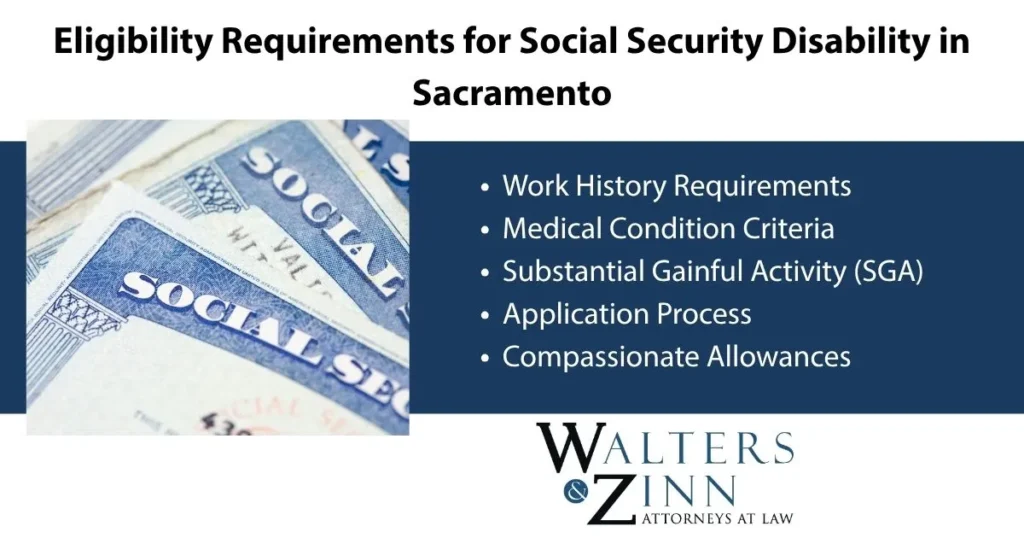
You need to meet the following criteria to become eligible for SSDI payments:
Odds are that your initial SSDI claim will be denied. The agency denies more than half of initial claims for various reasons. In some cases, the SSA believes that you either do not have a severe condition, or what you do have does not significantly limit your basic work tasks.
Having your claim denied is understandably upsetting, and it is certainly bad news when you were counting on the benefits. The good news is that the SSA does not get the last word. As an applicant, you are entitled to due process. There are several layers of this due process that you can avail yourself of to challenge the initial decision.
The SSDI appeals process has four levels. Applicants generally have 60 days after receiving a decision to move to the next level.
Missing a deadline can mean starting over with a new application, which delays benefits even longer.
Clients choose Walters & Zinn, Attorneys at Law because the firm has focused on Workers’ Compensation and Social Security disability claims since 1993. From its office in Folsom, California, the firm helps injured and ill workers pursue the benefits they need when they can no longer earn a steady income.
Disability claims involve strict deadlines, detailed medical records, and a review process that denies many first-time applicants. The Social Security Administration requires proof that a condition prevents substantial work and is expected to last at least 12 months or result in death. Walters & Zinn, Attorneys at Law, help clients meet that standard by:
Many clients have both a work injury and a long-term disability, and the two benefit systems interact in ways that can reduce payments if a claim is not handled carefully. Having both claims under one roof gives clients a single team that sees the full picture.
Clients also value clear communication. Past clients have said the firm kept them informed at every stage, which eases stress during a difficult time.
The government does not make it easy for you to get Social Security disability benefits. They are known for having a very high rate of denial on initial disability claims, forcing you to file an appeal. The good news is that many claimants win their cases on appeal and end up getting the benefits they deserve, but this may only come after a fight.
It usually takes the SSA six to eight months to review your disability claim and issue its determination. Regardless of the speed, you cannot receive disability payments until at least five months after the onset of your disability. However, when your first check comes, you are paid retroactively to the date when you first became eligible to receive disability benefits, after the waiting period.
You must file an SSDI appeal within 60 days of receiving your denial letter. The Social Security Administration assumes you receive the letter five days after the date printed on it, giving you a total of 65 days from that date to submit your appeal request online or by mail.
SSDI and SSI both pay monthly benefits to people with disabilities, but they work differently. SSDI is based on a person’s work history and the Social Security taxes they paid. SSI is based on financial need and limits how much income and resources a person can have, regardless of work history.
If you are filing an initial disability claim, or if you have received a denial of one that you have already submitted, get legal help from our Sacramento Social Security disability lawyers at Walters & Zinn, Attorneys at Law. We can work to simplify what is a difficult and opaque process and fight for you to receive the benefits you deserve under the law. To schedule a free consultation, contact us online or call today at 916-610-4706. With office locations in Folsom and Fairfield, California, we proudly serve clients in the surrounding areas.
Se Habla Español